
Typhlophis squamosus
(Schlegel, 1839)
Common Name: Blind Snake
Scientific Name: Typhlophis squamosus
Dentition: Aglyphous
Snake Type: Non-venomous
Geographic Distribution: Venezuela, Guyana, French Guiana, and Brazil; Trinidad
Distribution in Venezuela: Bolívar State


General Description
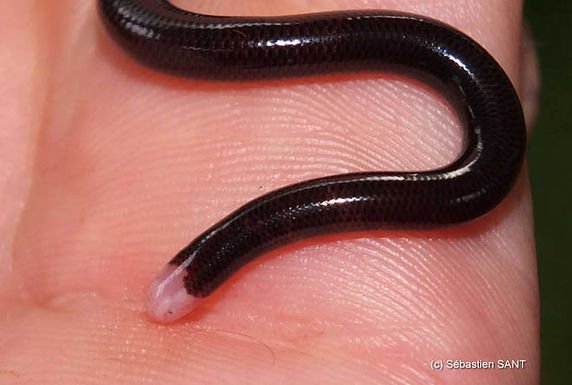
Typhlophis squamosus is a small, non-venomous snake highly specialized for subterranean life, belonging to the family Anomalepididae. It has a cylindrical, compact body with well-defined scales and a more pronounced body texture than other blind snake genera, a feature reflected in its specific name, squamosus.
The head is poorly differentiated from the neck, and the eyes are extremely reduced, functioning only for light perception. Its coloration is generally dark and uniform, in shades of brown, dark gray, or blackish, without conspicuous patterns. It is an oviparous species, consistent with the general biology of the group.
Its morphology reflects extreme adaptation to fossorial life, allowing it to move efficiently through compact soils, deep leaf litter, and substrates rich in organic matter.
Distribution and Habitat in Venezuela
Typhlophis squamosus has a Guianan distribution in northern South America, with confirmed records in Venezuela, Guyana, French Guiana, and Brazil. In Venezuela, it has so far been documented only in Bolívar State, making it a poorly recorded species at the national level.
Known Venezuelan specimens come from macrothermic sclerophyllous forest environments in the southern part of the country. Some individuals were found at approximately one meter underground, unearthed during bauxite mining activities in the Los Pijiguaos region of Bolívar State, at around 650 meters above sea level. Another specimen was collected in the Imataca area, also in Bolívar State. Surface detection is exceptional and usually associated with deep soil disturbance rather than natural surface activity.
Behavior and Ecology
Typhlophis squamosus is strictly fossorial, spending nearly its entire life underground. Its activity is closely linked to soil structure and moisture, which explains its extreme rarity in conventional field observations.
Its diet consists of small soil invertebrates, probably larvae and other soft-bodied organisms, playing an important ecological role in subterranean community dynamics and soil health. It shows no evident defensive behavior and poses no medical risk to humans.
Conservation
The conservation status of Typhlophis squamosus is poorly known, mainly due to its cryptic biology and limited records. However, it may be affected by deep soil disturbance, deforestation, and extractive activities that alter its subterranean habitat.
The conservation of this species depends on maintaining well-structured forest ecosystems and practices that reduce severe soil degradation.
Notes
- In Venezuela, the species is confirmed only for Bolívar State, but there is taxonomic controversy related to the synonymy of Typhlophis ayarzaguenai, originally described from Bolívar and later synonymized with T. squamosus.
- Some morphological characters, such as scale counts and details of the ocular and caudal regions, suggest that species delimitation requires a thorough modern revision.
- Sexual dimorphism has been detected in caudal characters, including the terminal mucronate keel.
- It is one of the least known and most cryptic snakes in Venezuelan snake fauna.

<<Click, download and collect the
Infographic
of the snakes found in Venezuela
Did you find this information about Venezuelan snakes useful?
At Fundación Vivarium, we work to educate communities, prevent snakebite accidents, and promote the conservation of these species by combining science, public health, and respect for wildlife. Your support helps us continue creating educational resources, training communities, and reducing deaths and long-term complications caused by snakebites. 👉 Make a donation and help us save lives and protect biodiversity: DONATE NOW
Prevention is also shared.
If this information could help someone else, share it on WhatsApp, on your social networks, or send the link to someone who might need it. 👇