
Siagonodon septemstriatus
(Schneider, 1801)
Common Name: Striped Blind Snake
Scientific Name: Siagonodon septemstriatus
Dentition: Aglyphous
Snake Type: Non-venomous
Geographic Distribution: Venezuela, Guyana, French Guiana, Suriname, Brazil, and Bolivia
Distribution in Venezuela: Amazonas and Bolívar


General Description
Siagonodon septemstriatus is a slender, small, non-venomous blind snake in the family Leptotyphlopidae, similar to other “blind snakes” of Venezuela. Its body is adapted for a fossorial lifestyle: long, narrow, and with extremely reduced eyes that detect only light changes. The typical body pattern consists of a lighter base color (yellowish or beige) with seven distinct black dorsal stripes, giving rise to its English common name, the seven-striped blind snake. This contrast in coloration makes it easier to recognize alive or in preserved specimens.
The tail is short and ends in a minimally differentiated tip, typical of blind snakes. Scale counts include 14 rows around midbody, and there is no clearly differentiated supraocular scale, a diagnostic trait for Siagonodon at the genus level.
This species is oviparous, consistent with the general reproductive pattern of leptotyphlopids.
Distribution and Habitat in Venezuela
Siagonodon septemstriatus occurs in southeastern Venezuela, specifically in Amazonas and Bolívar states, associated with the Orinoco Basin and lowland evergreen forests. Its presence in Zulia has been cited in error; confirmed Venezuelan records are restricted to southern forested regions.
Elsewhere in South America, it is found in Guyana, Suriname, French Guiana, Brazil, and Bolivia, mainly associated with the Guiana Shield and tropical humid forests. The species is typically recorded from lowland forest habitats.
Behavior and Ecology
This species is strictly terrestrial and fossorial, spending most of its life underground or within leaf litter and loose soil, moving readily through natural tunnels or those made by other organisms.
Its diet consists of small soil invertebrates, such as ants, termites, and larvae, making it an important ecological contributor to the regulation of subterranean invertebrate communities and organic matter recycling in tropical soils. It poses no risk to humans, is non-venomous, and human encounters are usually incidental during soil disturbance.
Conservation
According to international assessments, Siagonodon septemstriatus is listed as Least Concern on the IUCN Red List, indicating it is not currently at high risk of extinction. However, due to its cryptic biology and fossorial habits, its true population density and trends remain poorly studied. Tropical forest disturbance and soil degradation could impact it locally, although parts of its range remain relatively intact.
Notes
- Siagonodon literally means “cutting tooth” (from Greek siago = “to cut” + odon = “tooth”), referencing jaw characteristics, although this species has the diminutive teeth typical of blind snakes.
- Unlike many other Neotropical leptotyphlopids, S. septemstriatus shows a clear dorsal pattern (seven black stripes), aiding visual identification in the field.
- Its presence in evergreen forests of the Guiana Shield links its biogeography to one of South America’s oldest continuous forest regions.
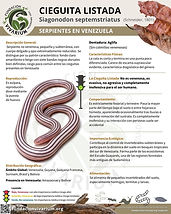
<<Click, download and collect the
Infographic
of the snakes found in Venezuela
Did you find this information about Venezuelan snakes useful?
At Fundación Vivarium, we work to educate communities, prevent snakebite accidents, and promote the conservation of these species by combining science, public health, and respect for wildlife. Your support helps us continue creating educational resources, training communities, and reducing deaths and long-term complications caused by snakebites. 👉 Make a donation and help us save lives and protect biodiversity: DONATE NOW
Prevention is also shared.
If this information could help someone else, share it on WhatsApp, on your social networks, or send the link to someone who might need it. 👇