
Can Clothing Protect you from a Snakebite?

Updated: Nov 19, 2025
A Reality in Latin America
In many rural regions of Latin America, snakebites remain a daily threat for farmers, coffee pickers, harvesters, hikers, and children playing near the forest. At Fundación Vivarium, we always recommend wearing high leather or other sturdy boots, since most bites occur on the foot, ankle, or calf.
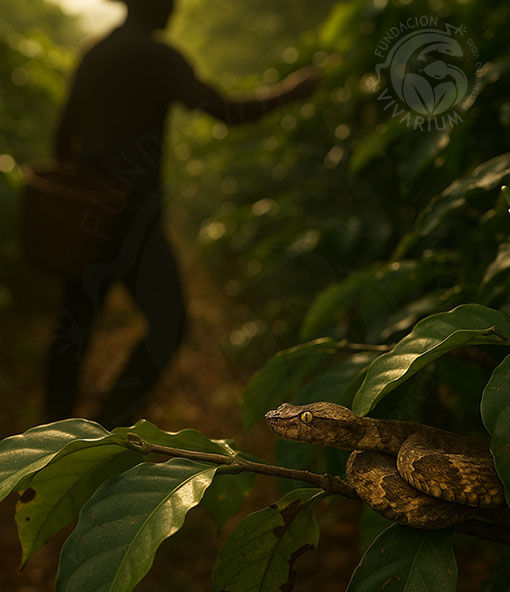
However, in our fieldwork with coffee farmers, we have observed a significant number of bites on hands, arms, and shoulders, associated with harvesting tasks and with a behavior that, although uncommon, we have documented in lancehead pit vipers (Bothrops spp.): juvenile specimens—usually found on the ground—have shown the ability to climb shrubs with abundant branches and foliage, using them as sunbathing spots or to hunt small birds.
For this reason, in addition to boots, we recommend wearing thick clothing and protective gloves. This recommendation has led to a frequent question:
Can clothing really protect us from a snakebite?

Although many people assume that medically important snakes can pierce any fabric, new studies and real-world experiences suggest something interesting:
The right clothing can lessen the severity of envenomation, although it does not prevent the bite.
In this article, we explore scientific evidence published in an international journal, compare it with a real case in Venezuela, and share recommendations to prevent snakebite accidents.
Can Clothing Protect you from a Snakebite? What Science Found
A study published in Annals of Emergency Medicine (Herbert & Hayes, 2009) analyzed how venomous snakes (Crotalus helleri) reacted when biting a human arm model with and without denim clothing. They used gloves filled with warm saline solution to simulate a human limb and provoked defensive bites both on uncovered gloves and on gloves covered with denim.
The results?
The snakes injected 60–66% less venom into the denim-covered models.
In many cases, venom remained on the fabric, or the bite was “dry” (without venom injection).
Fang contact time was similar, indicating that the fabric interfered with the efficiency of the injection mechanism, not with the snake’s behavior.
Although the study was conducted with North American rattlesnakes, the findings may be partially applicable to similar species in Venezuela and Latin America, such as South American rattlesnakes (Crotalus spp.) and lanceheads (Bothrops spp.), which share the same solenoglyphous fang type.
Field Experience: José’s Case
José, a 26-year-old coffee farmer from Táchira state (Venezuela), was bitten in July 2025 by a juvenile Bothrops while harvesting.
He was wearing a sleeveless undershirt, a T-shirt, and a thick sweater. The bite occurred on the shoulder, and only a single fang mark was observed.
According to witnesses, after feeling the sting, José quickly removed his clothing with his brother’s help.
His brother applied pressure around the wound, from which a yellowish liquid emerged.
Clinically, he presented with a very mild case: mild pain, no swelling, no skin discoloration, no bleeding. He received a kit of polyvalent antivenom, developed no systemic complications, and was discharged in record time.

Hypothesis:
The thick clothing layers may have interfered with the deep penetration of the solenoglyphous (retractable and protractile) fangs of the lancehead, or prevented the full projection of one of the two fangs.
Some venom may have been trapped in the clothing or superficial skin layers, reducing the risk of reaching deep blood vessels.

This case matches the study’s findings: clothing did not prevent the bite but may have reduced the quantity and depth of venom injected.
What You Should Know
Thick clothing does not prevent a bite, but can reduce its severity.
The thicker or denser the clothing, the more resistance it offers against the fang’s penetration.
Clothing can act like a “sponge,” trapping part of the venom.
Recommendations for Rural Areas:
Wear canvas, industrial fabric, heavy jeans, or thick denim pants (avoid lycra or shorts).
Long-sleeved shirts, preferably double-layered or with reinforced fabric.
Rubber boots in good condition or leather boots covering the ankle and calf. Never walk barefoot or in sandals in high-risk areas.
The traditional Venezuelan llanero hat provides excellent sun protection—and can also help shield against snakes from above.
Don’t forget to protect your hands: although many dismiss heavy leather gloves for being uncomfortable or reducing sensitivity, they can be an important barrier against unexpected bites, especially when picking branches, lifting objects off the ground, or working among bushes. Today there are more ergonomic, fitted models made of flexible leather or mixed materials, which maintain good mobility and tactile sense while offering added protection against fangs. In risky tasks, it is better to lose a little precision than to suffer a serious hand bite.
Conclusions
Dressing appropriately does not eliminate the risk, but it can be an effective way to reduce the severity of a snakebite. Combined with other measures (education, proper land management, informed brigades), clothing becomes a simple and accessible preventive tool.
This scientific finding, reinforced by real cases like José’s, allows us to offer a clear recommendation: Dress smart if you live or work in the countryside—or even if you’re going for a hike in the forest.
Referencia: Herbert, S. S., & Hayes, W. K. (2009). Denim Clothing Reduces Venom Expenditure by Rattlesnakes Striking Defensively at Model Human Limbs. Annals of Emergency Medicine, 54(6), 830–836. Download Pdf:
Get Involved & Share
What other snake-related topics would you like us to explore on our blog? Leave your comment below! You can also read the thread on our X.com
❤️ If you value our educational work and want to help us prevent snakebite deaths in Venezuela, please consider making a donation.Your support makes a difference 👉 https://www.fundacionvivarium.org/dona
Did you find this information useful?Help us reach more people: share this article on your social media or copy the link and send it to someone who might need it. Prevention is meant to be shared!
⭐️⭐️⭐️⭐️⭐️ Leave us a review on Google!



Comments